
Noorani Qaida Page 02 - Lesson 01: Huroof-e-Mufradat (Single Letters)
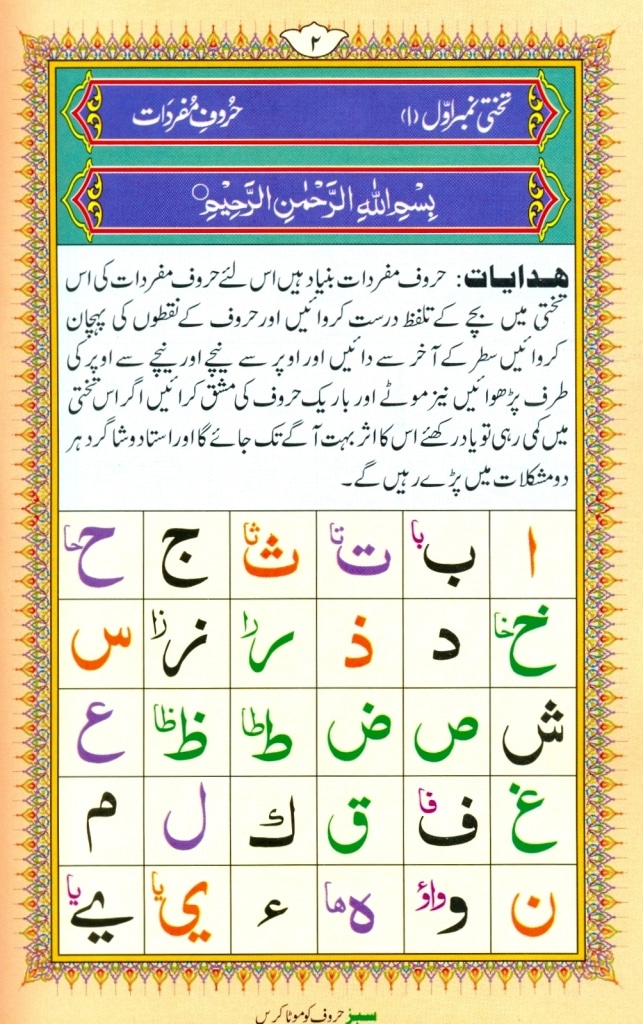
🔊 Practise these letters with sound: use our free Arabic Alphabet with Sound tool to hear every letter of this lesson, see where it comes from in the mouth and test yourself with a quick quiz.
What is Covered in Noorani Qaida Page 02?
Lesson 01 focuses on building letter recognition and precise pronunciation habits right from the start:- The 29 Arabic Alphabets: Practice individual letter recognition from Alif (ا) to Ya (ے).
- Makharij (Correct Articulation): Learning how each letter originates from specific parts of the throat, tongue, lips, or oral cavity.
- Heavy vs. Light Letters: Differentiating between full-mouth/heavy letters (Huroof-e-Musta’liyah like خ, ص, ض, ط, ظ, غ, ق) and soft/light letters (Muraqqaq).
- Teacher Guidelines (Hidayat): Following proper guidance to ensure children do not stretch single letters into long vowels unnecessarily.
Key Tajweed Rules to Focus On Page 02
When practicing Page 02, ensure you focus on the following essential Tajweed fundamentals:- Alif (ا): Read softly without blowing air or stretching.
- Throat Letters (Huroof-e-Halqi): Pay special attention to letters produced in the throat: Eyn (ع), Ha (ح), Kh’a (خ), Gh’ayn (غ), Hamzah (ء), Ha (ھ).
- Bold / Heavy Letters: Pronounce ص (Saad), ض (Daad), ط (Taa), ظ (Zaa) with a full mouth to avoid mixing them up with soft counterparts like س (Seen) or ت (Taa).
Complete Page-by-Page Lesson Directory
Navigate directly to any page in the Noorani Qaida curriculum:
Page 02
Page 03
Page 04
Page 05
Page 06
Page 07
Page 08
Page 09
Page 10
Page 11
Page 12
Page 13
Page 14
Page 15
Page 16
Page 17
Page 18
Page 19
Page 20
Page 21
Page 22
Page 23
Page 24
Page 25
Page 26
Page 27
Page 28
Page 29
Page 30
Page 31
Page 32
Explore Our Free Islamic Utility Tools
Enhance your daily Islamic practices with our online interactive Islamic Tools:- Hear and practise every letter on our Arabic Alphabet with Sound tool.
- Count daily recitations effortlessly on our Digital Tasbih Counter.
- Locate the exact Qibla direction with our Qibla Finder.
- Convert dates accurately with the Hijri Date Converter.
- Search meaningful names using our Islamic Names Finder.
- Calculate obligations using the Zakat Calculator and Islamic Inheritance Calculator.