
Noorani Qaida Page 15 - Lesson 09: Practice Exercise of Harkat, Maddah, Leen & Tanween
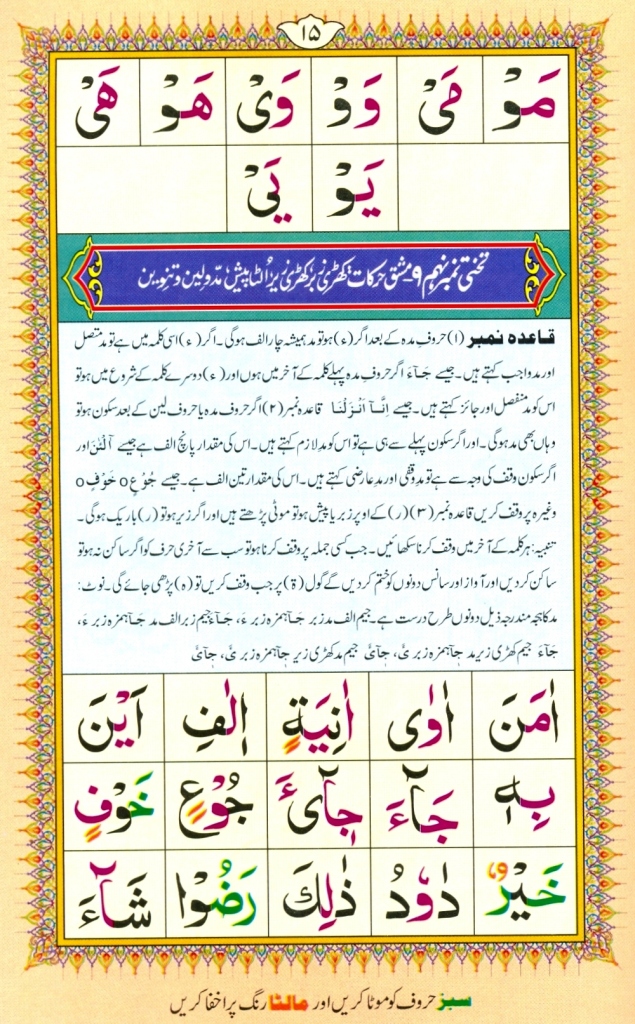
Welcome to Noorani Qaida Page 15 at Learning Quraan. On this page, we conclude the remaining sets of Huroof-e-Leen and begin Takhti Number 09 (تختی نمبر نہم)—a comprehensive practice exercise combining short vowels (Harkat), long vowels (Huroof-e-Maddah), soft vowels (Huroof-e-Leen), vertical vowels (Khari Harkat), and double vowels (Tanween)[cite: 15].
Help your child master combined Tajweed rules and build complete confidence in Quranic word recognition. Enroll them in our structured Online Noorani Qaida for Kids program, or explore all available courses on our Courses page.
What is Covered in Noorani Qaida Page 15?
Page 15 is structured into two main educational segments[cite: 15]:
- Final Huroof-e-Leen Sets (Top Section):
- Meem (م): Mau (مَوْ), Mai (مَيْ)[cite: 15]
- Waw (و): Wau (وَوْ), Wai (وَيْ)[cite: 15]
- Ha (هـ): Hau (هَوْ), Hai (هَيْ)[cite: 15]
- Ya (ي): Yau (يَوْ), Yai (يَيْ)[cite: 15]
- Takhti Number 09 – Word Practice Exercise (Bottom Section): Practicing multi-letter Quranic words to apply all fundamental vowel rules simultaneously[cite: 15]:
- Aamana (آمَنَ): Combines Alif Maddah / Khari Fatha with Harkat[cite: 15].
- Aawaa (اٰوٰى): Practice with multiple Khari Fatha sounds[cite: 15].
- Aaniyatin (اٰنِيَةٍ): Exercise featuring Khari Fatha, Kasra, Fatha, and Kasratain (Tanween)[cite: 15].
- Ielaafihim (إِلٰفِهِمْ): Practice with Khari Fatha and Sukoon[cite: 15].
- Ayna (أَيْنَ): Practice with Ya Leen followed by Fatha[cite: 15].
- Bihee (بِهِ): Practice with Khari Kasra[cite: 15].
- Jaa’a (جَآءَ) & Jaa’at (جَآءَتْ): Introduction to Madd-e-Muttasil (Connected Obligatory Prolongation)[cite: 15].
- Joo’in (جُوعٍ): Practice with Waw Maddah and Kasratain[cite: 15].
- Khawfin (خَوْفٍ): Practice with Waw Leen and Kasratain[cite: 15].
- Khayrun (خَيْرٌ): Practice with Ya Leen and Dammatain[cite: 15].
- Daawoodu (دَاوُدُ): Combines Alif Maddah, Waw Maddah, and Damma[cite: 15].
- Zaalika (ذٰلِكَ): Combining Khari Fatha with Kasra and Fatha[cite: 15].
- Radhoo (رَضُوا): Combining Fatha, Damma, and Waw Maddah[cite: 15].
- Shaa’a (شَآءَ): Practice with Madd-e-Muttasil[cite: 15].
Key Tajweed Rules for Lesson 09 Practice
When reciting the exercise on Page 15, apply these key Tajweed principles[cite: 15]:
- Distinguishing Maddah vs. Leen: Elongate Maddah sounds (e.g., Joo’in) for 2 counts, but pronounce Leen sounds (e.g., Khawfin, Khayrun) smoothly and quickly without stretching[cite: 15].
- Madd-e-Muttasil (Connected Stretch): When a Hamza (ء) appears within the same word directly after a Madd letter (indicated by a curved wave sign `~`), stretch the vowel sound for 4 to 5 counts (e.g., Jaa’a, Shaa’a)[cite: 15].
- Clear Distinction of Harkat: Ensure short vowel marks (Fatha, Kasra, Damma) are pronounced sharply without adding accidental elongation[cite: 15].
Complete Page-by-Page Lesson Directory
Easily navigate to any page in our complete online Noorani Qaida guide:
Page 03
Page 04
Page 05
Page 06
Page 07
Page 08
Page 09
Page 10
Page 11
Page 12
Page 13
Page 14
Page 15
Page 16
Page 17
Page 18
Page 19
Page 20
Page 21
Page 22
Page 23
Page 24
Page 25
Page 26
Page 27
Page 28
Page 29
Page 30
Page 31
Page 32
Explore Our Free Islamic Utility Tools
Support your daily worship and learning routines with our free interactive web tools on the Islamic Tools page:
- Keep count of daily dhikr with our Digital Tasbih Counter.
- Find the accurate direction of the Qibla using the Qibla Finder.
- Convert dates accurately with the Hijri Date Converter.
- Search meaningful Islamic names using the Islamic Names Finder.
- Calculate Islamic obligations via our Zakat Calculator and Islamic Inheritance Calculator.
Get One-on-One Tutoring Support
Learn more about our certified teachers on the About Us page, view pricing on the Fee structure page, or visit our Contact Us page to schedule a free trial session.