
Noorani Qaida Page 32 - Words Written Differently in Quran Script & Recitation Qualities/Errors
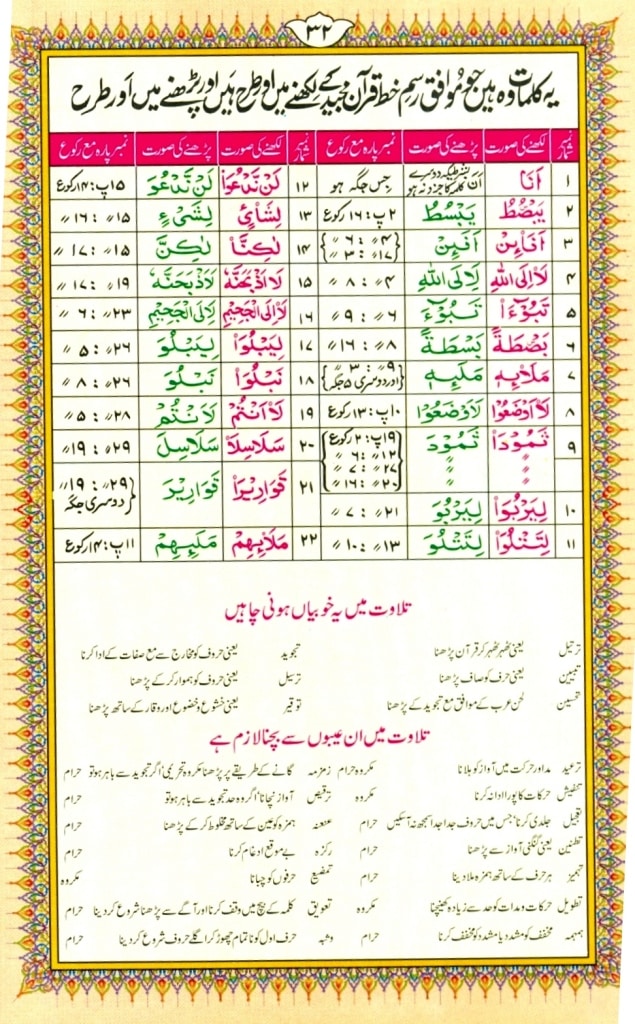
Welcome to Noorani Qaida Page 32 at Learning Quraan[cite: 12]. This final page of the Noorani Qaida features a specialized comparative table of words written according to the standard Quranic script (Rasm-e-Khat-e-Uthmani) alongside their reading and pronunciation forms, followed by essential guidelines on recitation qualities and errors to avoid[cite: 12].
To further polish your Quranic recitation with expert live tutors, explore our Online Noorani Qaida for Kids program or browse our comprehensive curriculum on the Courses page[cite: 12].
Page 32 Structure & Breakdown
1. Comparative Table: Words Written vs. Read in Quranic Script
This table outlines words that are written in a specific form according to standard Quranic orthography but are pronounced differently based on Tajweed rules[cite: 12]:
- Row 1 (اَنَا): Written as اَنَا but read without the Alif when continuing (or read with specific rules depending on context)[cite: 12].
- Row 2 (يَبْسُطُ): Demonstrates differences in script writing with Sad/Seen variants across specific Surah references[cite: 12].
- Row 3 (اَنَاْيْنُ – اَنِيْنُ): Contrasts script form with correct phonetic delivery[cite: 12].
- Row 4 (لَا اِلَى اللهِ): Focuses on connecting lam and alif forms smoothly[cite: 12].
- Row 5 (تَبَوَّءَا): Highlights dual forms and Maddah application in specific Quranic locations[cite: 12].
- Rows 6-11: Cover specialized orthographic rules for words like بَسْطَةً, مَلَإِيْهِمْ, لَا اَوْضَعُوا, تَمُوْدَا, يَبْرُؤُوا, and لِيَتَّلُوكَ across various Paras and Rukus[cite: 12].
2. Tilaawat Mein Yeh Khubiyan Honi Chahiyan (Qualities of Good Recitation)
- Tarteel (ترتیل): Reciting the Quran clearly and slowly with proper adherence to Tajweed rules[cite: 12].
- Tajweed (تجوید): Pronouncing every letter from its proper articulation point (Makhraj) with all its inherent characteristics[cite: 12].
- Tarteel / Tarteel-e-Lafzi (ترسیل): Pronouncing letters smoothly, fluently, and clearly without rushing[cite: 12].
- Taqweer / Waqar (توقیر): Reciting with humility, reverence, awe, and dignity[cite: 12].
3. Tilaawat Mein In Uyun Se Bachna Lazim Hai (Errors to Avoid in Recitation)
The lower section details forbidden or discouraged habits (Makrooh/Haram) during Quran recitation[cite: 12]:
- Tar’eed (ترعید): Trembling or shaking the voice excessively like weeping outside of natural emotion[cite: 12].
- Tatleesh (تطلیش): Failing to pronounce vowel movements (Harakat) fully[cite: 12].
- Tafeel (تفعیل): Rushing or making letters merge improperly so that individual letters become indistinct[cite: 12].
- Tatneen (تطنین): Humming or singing letters in a musical tone[cite: 12].
- Tamyeez (تمئیز): Mixing up Hamza and other letters incorrectly[cite: 12].
- Tatweel (تطویل): Lengthening short vowels or extending stretches beyond their prescribed counts[cite: 12].
- Tamkheef (تخفیف): Lightening or shortening Shaddah or Sukoon letters inappropriately[cite: 12].
- Zamzama (زمزمہ): Reciting in a singing or chanting style that violates proper Tajweed[cite: 12].
- Tarteeq (ترتیق): Raising the voice into singing tones when it violates Tajweed limits[cite: 12].
- Adana (عدنہ): Joining Hamzaing with exaggerated throat scraping[cite: 12].
- Rakwa (رکوۃ): Making Idgham or pauses in incorrect places[cite: 12].
- Tamsek (تمسیع): Chewing or swallowing words/letters indistinctly[cite: 12].
- Taweeq (تعویق): Pausing awkwardly in the middle of a word or rushing ahead incorrectly[cite: 12].
- Wajh (وجہ): Dropping the first letter or starting subsequent letters incorrectly[cite: 12].
Complete Page-by-Page Lesson Directory
Quickly access any page across our online Noorani Qaida curriculum[cite: 12]:
Page 03
Page 04
Page 05
Page 06
Page 07
Page 08
Page 09
Page 10
Page 11
Page 12
Page 13
Page 14
Page 15
Page 16
Page 17
Page 18
Page 19
Page 20
Page 21
Page 22
Page 23
Page 24
Page 25
Page 26
Page 27
Page 28
Page 29
Page 30
Page 31
Page 32
Explore Free Interactive Islamic Tools
Make use of our helpful online utilities on the Islamic Tools page[cite: 12]:
- Count daily Dhikr using the Digital Tasbih Counter[cite: 12].
- Find accurate prayer directions worldwide with the Qibla Finder[cite: 12].
- Switch between Gregorian and Hijri calendars instantly with the Hijri Date Converter[cite: 12].
- Discover meaningful baby names on the Islamic Names Finder[cite: 12].
- Compute religious obligations via the Zakat Calculator and Islamic Inheritance Calculator[cite: 12].
Book Your Free Live Trial Class
Learn about our expert tutors on the About Us page, view our affordable packages on the Fee page, or get in touch via our Contact Us page to schedule your free trial class[cite: 12].